

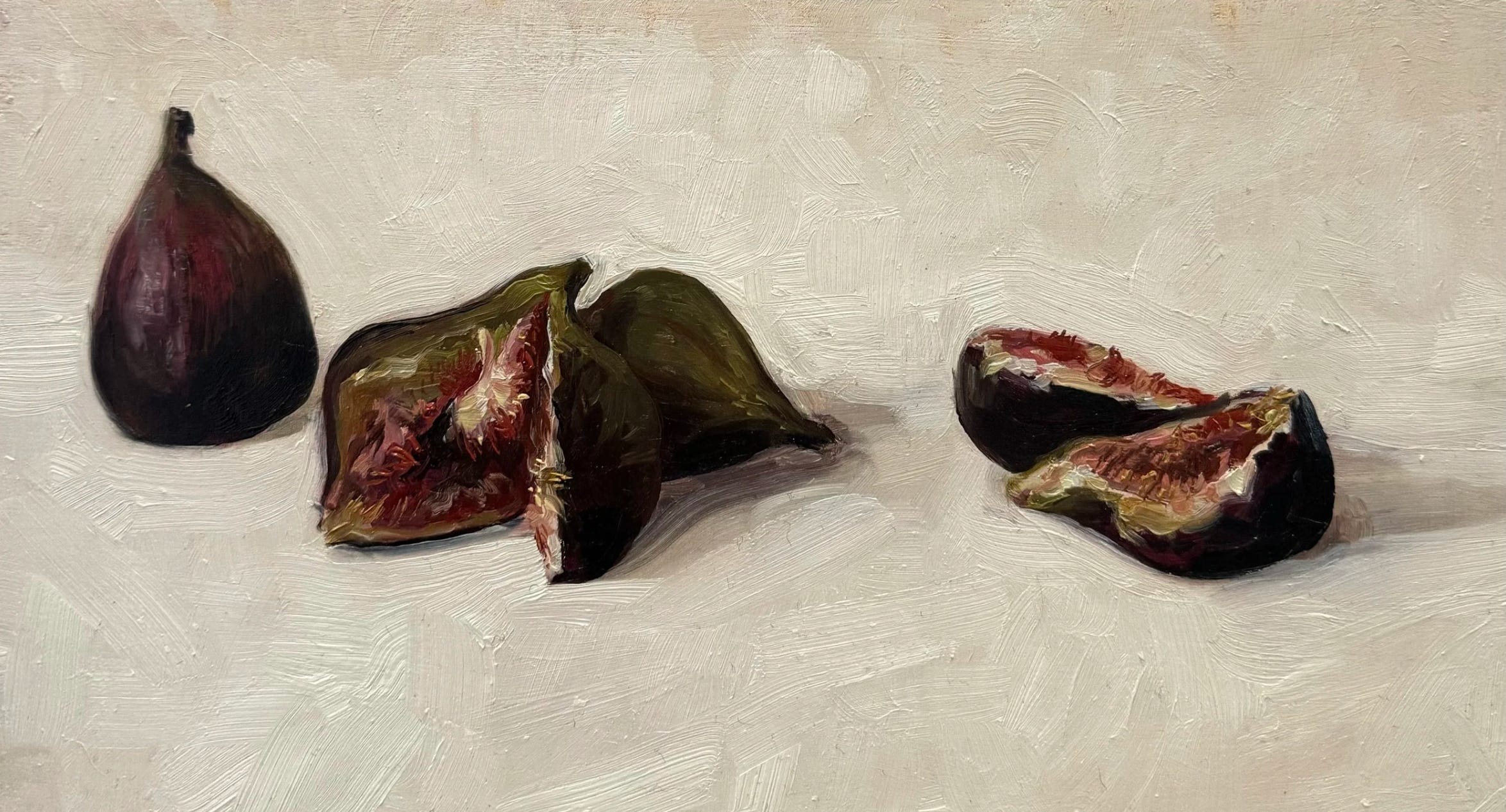
There are many lost worlds. In the early mornings along the green corridor in Singapore, an orchestra of sound. Cicadas. Songbirds. The modulations of light and shadow, burned grass and trumpet shaped Chinese violets. The home that we lived in for 9 years was demolished entirely, down to the splinters.
Some things don’t change. H and I drink Pu-erh tea in a traditional Chinese teashop on Neil Road, sitting cross-legged on the floor until we’re giddy from caffeine. We name it her year of slicing the Gordian knot: she had a complex set of problems causing misery, and one decision solved everything in one fell swoop.
H speculates about fate. I don’t know if I believe that all paths lead somewhere predestined. I take the stance that most decisions don’t matter at all, only one or two picked well fundamentally alter the course of your life. When a window opens you have to flood in. With that comes all the anxieties I liken to trading on margin: the heart-wrenching feeling of putting all of your chips in, and then some.
My smartest friends are constantly plagued by the question of how to optimize their lives. Mostly because they believe in hustle and slog, and magnitude means nothing without direction. I call this experience “choice loneliness.” You’re not necessarily lonely in a holistic sense, but in a localized way. You might have a close knit community of peers and people who love you. But no one can determine the true size or shape of your life. When to dig your heels in and work like a dog, nor when to cut your losses after a long and thankless slog. Anne Lamott once said writing a novel was like driving a car at night. You can see only as far as your headlights, but you can make the whole trip that way. Similarly when forging illegible paths, you can only see a few turns ahead. You learn to stomach the abyss for an unbearably long time.
The line of our life only solidifies behind us, it becomes coherent as it fossilizes into the simplicity of destiny, Mircea Cărtărescu writes in Solenoid,
While the lives that could have been, that could have diverged, moment by moment, from the life that triumphed, are dotted, ghostly lines: creodes, quantum differences, translucid and fascinating like stems vegetating in the greenhouse. If I blink, my life forks: I could have not blinked, and then I would have been far different from the one who did, like streets that radiate out from a narrow piaţa.
Does desire leave anyone intact? Life forks in less than a blink. All of a sudden the decision parameters upon which you assess success have been reconfigured. That is the very underpinning of transformation: you can’t predict how it will warp you or turn you into who you weren’t before. It simply feels like acute recognition at the site of change: the way you recognize a perfect fit on a pair of jeans, or begin to fall for someone. It’s just like, Oh.
Maybe I’d be content with any fate because I’d have chosen it. A flat in London with a dog and two children and a routine morning jog. A creaky Victorian rowhouse near NoPa, or someplace in Montana or Seattle waking up to a body of water. Saturation, Ada Limon writes about the Kentucky sky, that feeling when you’re really full, or life is full and you can’t think of anything else that could fit into it and then even more sky comes. More sky it is. Shanghai, Hong Kong, Singapore. And you’d be a poet or a founder or a trader or a psychotherapist or a gold rush AI researcher or an free agent playing singular games. When the world is malleable as it is right now, what do we do with ourselves?
Stop agonizing, you say. Anywhere you’d be pleased by the simpler things. The crispness of morning air. A breakfast of toast and eggs and dark roast coffee with cream. In the motionless dark, I run loops around an empty plot of land. In the imagined future, I still hear the cicadas and birds sing.

PS: Thank you for reading - if you feel inclined; please like or share this post. Your support helps me curate more posts and reach more readers.

I’ve missed making consumption archive! Here we go with some recent enjoyments
Zadie Smith’s Notes on Attunement for the New Yorker (Ty for the recommendation Nabeel S. Qureshi) inspired my latest essay on modern art.

Alongside that mention, Nabeel’s excellent essay on close reading Proust’s In Search of Lost Time convinced me to finally start the set.
I reread Jon Repetti’s piece on love and individuality once a month since he posted it in 2024. The end of fantasy is the beginning of real love:
These tiny imperfections, the little eruptions of the real into the fantasy of the other, are what make up the real substance of love, what Lacan would call after Socrates “the agalma” of the other, their “hidden treasure.”
Up there with pieces I’ve reshared multiple times is lillian fishman for The Metropolitan Review: Would You Rather Have Married Young on experience vs happiness
Sasha Chapin’s as sweet as razor blade honey - Sasha always arranges words in such a precise and surprising way, it’s impossible to predict the next token:
There is no strategy that will contain what is inside us, so we simply burst. And if we are lucky, we have the fortitude to notice: oh, it is really interesting to burst open. Look at all the scraps I’m made of.
Alexander Chee on taking a class taught by Annie Dillard at Wesleyan.
Haley Nahman’s advice on following your non-specific dreams
I think this is the aspect of luck that’s sometimes missed in career mythology. Not that if it doesn’t strike, you’re doomed, but that luck—which we all need a little of, and usually encounter at some point, although some more than others—can’t lead you somewhere specific, but if you meet it with the right attitude, can lead you somewhere unexpected
Sheon Han for Asterisk Magazine Reading Lolita in the Barracks in Korean military service


Merve Emre’s interview with Rachel Cusk
The Eros Monster by Agnes Callard
The old story is that eros induces self-destruction by way of emotion: it controls, redirects, and poisons one’s feelings. But eros commits crimes of passion because, first and foremost, it commits crimes of thought. It attacks the heart by way of the mind. Eros is an intellectual monster.
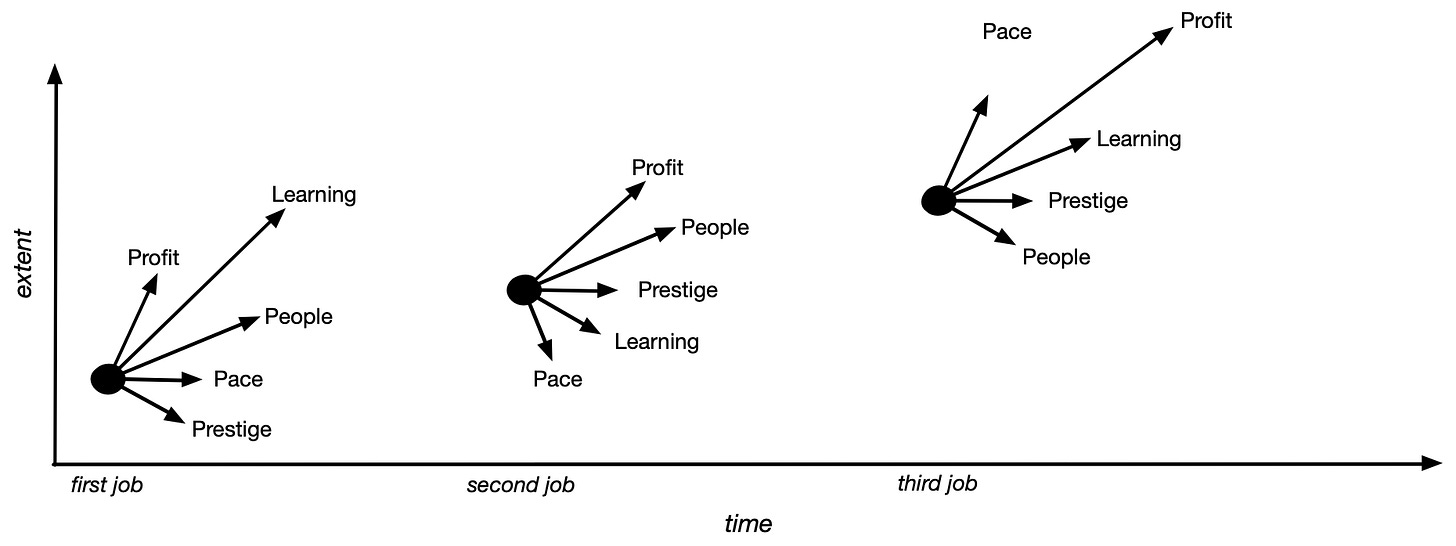
Will Larson’s reflections on a Forty Year Career
Jake Eaton, Sam Bowman, and Kyle Fish on Claude Finds God was highly intriguing and introduced me to my new most used emoji: 🌀. Claude is just like me!
For readers who aren't familiar, this is a behavior where two Claudes talking to each other, after a sufficient number of turns, appear to converge in some sort of feedback loop in a state that sounds a lot like Buddhism or Eastern mysticism.
America The Beautiful on Scott F. Fitzgerald
Why I Broke Up with New York by Lena Dunham
In Praise of Shadows exploring the Eastern beauty and principles around light and shadow, and more broadly on Japanese aesthetics by Jun'ichirō Tanizaki.
The Crane Wife by CJ Hauser


"That is the very underpinning of transformation: you can’t predict how it will warp you or turn you into who you weren’t before. It simply feels like acute recognition at the site of change: the way you recognize a perfect fit on a pair of jeans, or begin to fall for someone. It’s just like, Oh"
Yes! And, a corollary of this is honing your sense of when and where you might be - how to put yourself at "the site of change" more often. You can't force it. But you can maybe tip the odds a bit :-)
cheering at the return of the consumption archive! reading annie dillard's "teaching a stone to talk" for the first time, and chee's essay is the perfect accompaniment