

I can count on one hand the number of people whose lives I am actively engaged in. Chalk it up to Dunbar’s number or other such simplifications. You’re working hard, moving to a new city, getting married soon. I see glimpses on social media: little boxes of smiling faces and apparitions of places. A local haunt, a national park, a tapas place that serves sour olives and chilled red wine, a crevice, a court booking, a cathedral. How many twists and turns make a life? How many of them lead us back to one another?
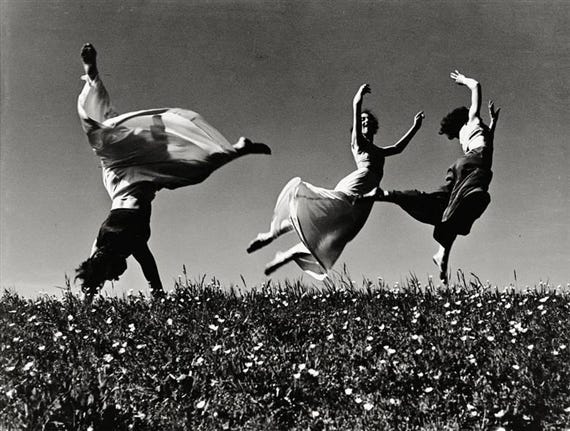
This year, my close friend Vedika and scheduled a aspirational recurring ‘weekly goals call’ calendar invite to make progress on amorphous dreams we had set for ourselves. Despite long haul flights, career transitions and general turbulence, we managed to commit to a call every week. Often it would spill past allotted time. “Meetings” sometimes digressed into afflictions of the heart or news from the street. But on all accounts it was an unparalleled hope-inducing mechanism. Last month we sat in Aziza and celebrated, over a course of inventive colorful vegetarian dishes, reaching one of her big goals.
One paradigm of friendship is active and intensive. Another is more passive, observational. I find the former to be exceedingly rare but worth searching for. According to Emerson, a friend is one “with whom I may be sincere. Before him I may think aloud.” To me, the highest virtues of friendship is to invest in one another’s transformation, and be made more brave.
“The high return of raising another person’s aspirations”
On Lenny Rachitsky’s recent podcast, Tara Seshan referenced a short Marginal Revolution post, which frames the high return activity of raising other’s aspirations as one of the most valuable things you can do with your life:
At critical moments in time, you can raise the aspirations of other people significantly, especially when they are relatively young, simply by suggesting they do something better or more ambitious than what they might have in mind. It costs you relatively little to do this, but the benefit to them, and to the broader world, may be enormous.
But I’d differ on cost. I think it’s no easy feat. To feel psychologically safe enough to describe lofty goals in painful detail, you must have faith that the person won’t ridicule or sabotage you or deem your desires small or unimportant. Paradoxically, they can’t merely comfort you either. The person also has to poke hard at your coping mechanisms or fanciful reasons for not trying as hard as they know you are capable of.
More broadly the process has made me believe that deep, utterly transformative change is possible if you have ample amounts of will. Also, if you have co-conspirators, what might’ve taken you a year to realize can be rapidly accelerated in a matter of months.

A few reasons why I thought the goals calls were particularly effective
Sharing granular volatility as opposed to median experience.
On a week to week basis, enthusiasm and motivation fluctuate greatly. Often when you catch up with friends you intersect with them somewhere in this volatile cycle. To sit through multiple cycles of euphoria and disbelief helps you calibrate to a person’s baseline level of neuroticism and patterns in thinking. For example, if you have perfectionist tendencies, an honest friend might observe neutrally that you that you regularly self-sabotage by way of hiding your work or overworking something beyond what is reasonable, or procrastinating action for months (if not years). We underestimate how obvious our patterns are outside of our own heads.
Discovering fictional boundaries by making contact with reality, aka “just ask.”
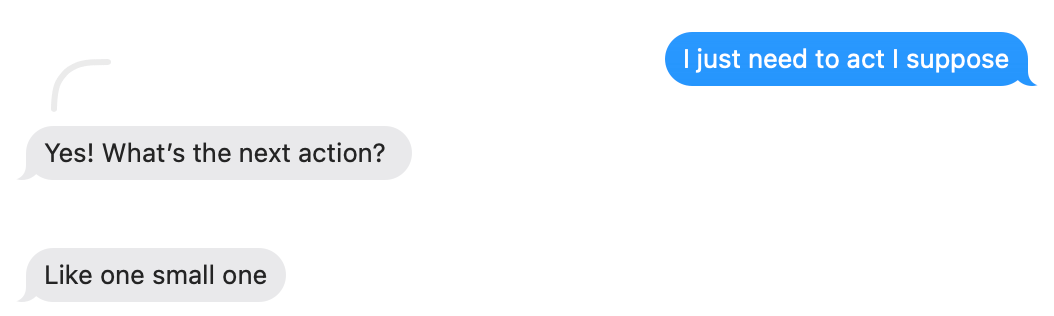
My recurring revealed preference dug up through this exercise, for example, is aversion to conflict. Asking for things is difficult! Especially if you grew up in rule-following environments where conflict is reserved for high-stakes matters. Frustratingly, habits that work in the environments of our childhood are not very useful or transferable to adulthood at all. It might’ve been useful to be meek once, but that is certainly no longer the case. When it came down to having direct, uncomfortable conversations, her advice was “just ask,” with the ultimate sentiment that all information is useful. Without the push I’d have shied away from the truth of any particular matter, because truths are inconvenient. Blurry stories are soothing because they allow for inaction. I began asking more, simply because I practiced asking — and I was pushed to ask often before I was ready.
“Brutally early club” and devastating sincerity
Potentially the hardest sentence to articulate in the world is: I want this thing and I’m going to try really hard for it. Sincerity can be devastating. When you approach the world with earnestness spilling out of you, people coin it Naïveté. But I’ve always found sincerity very charming. We must encourage each other’s earnestness!
I really liked the idea of The Brutally Early Club, by the Swiss Curator Hans-Ulrich Obrist, who put together a book club “to exchange views on enabling the future generation” across art, literature, and architecture
Together with Markus Miessen we invented the ‘Brutally Early’ session format to enable improvisation, because we feel that our daily lives don’t allow for much of it. We decided to do it at 06h30, for about two hours, because that’s when the city wakes up – and people don’t usually have other plans.
Brutally early in this case referred to the morning hour of convening for Obrist, but in my eyes Brutally Early can also be an ethos, a spirit, and a guiding principle. Brutally early means meeting before the world wakes up to discuss and to speak freely to one another about ideas that don’t belong during ‘working hours.’ Being brutally early means lots of doubt, rejection, timeline slips, wrong turns, losses of faith. Then flipped on its head: it’s still so early! There’s enough time, enough coffees and reworkings and daylight, to make something good.
Aspiration and Proleptic Engagement
Aspiration as Agency by Agnes Callard is a book I’ve been mentally returning to, where Callard outlines the structure of aspiration. You begin doing something, making progress toward a new identity, from a place of partial understanding, pulled forward by a hazy image of who you might become. Aspiring is a slow, vulnerable project of becoming, the “distinctive form of agency directed at the acquisition of values.”
An important idea as it relates to friendship is Callard’s point on proleptic engagement: pulling the concept of someone forward in time. Seeing the version of someone as they hope to be rather than who they presently are.
The word ‘proleptic’ refers, usually in a grammatical context, to something taken in advance of its rightful place. I appropriate it for moral psychology on the model of Margaret Little’s phrase “proleptic engagement”, by which she refers to an interaction with a child in which we treat her as though she were the adult we want her to become.
This means generously imagining the next version of someone far before they get there. I feel this all the time! When someone has an unwarranted belief in you, or sees you in a particularly generous light, it expands your capacity to meet it. This way of seeing could look like interpreting early attempts at change as part of a serious aspiration, not as hypocrisy or foolishness; or giving more trust and responsibility than they’re ready for.

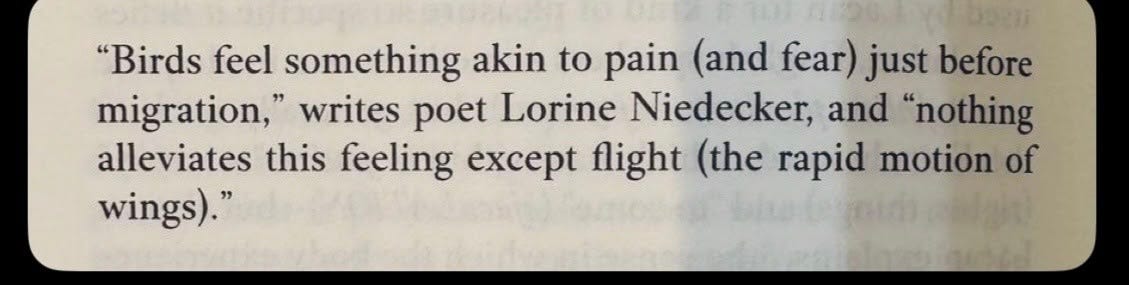
David Whyte’s definition of friendship describes witness as the ultimate touchstone, “the privilege of having been seen by someone, and the equal privilege of being granted the sight of the essence.” Essence is the right word because it is so pure. There is no muddying essence. The eidos of a person - what makes you indefatigably you. I could search for it elsewhere and never find it again. I feel lucky when I think of the scarcity of essence that makes someone particularly special to another. In many cases I believe this dynamic can also be constructed, built. Relationships can be co-evolutionary loops (Karlsson) in which we iterate through constraints together, attempt hard things (and sometimes fail), and live through the emergence of new situations and worlds. We raise another’s aspirations — and in doing so, raise our own.

side note
Thanks for reading. I apologize for being more absent than usual on here! I’ve been working hard at my job, and new ontologies (also on Substack) for a few exciting profiles on companies. I’ve been noodling on what topics and themes excite me and what I genuinely want to share with readers as opposed to posting for the sake of posting. Anyways, I think it’s good to constantly evolve. The only real leverage is self renewal after all :)
Speak soon, Nix.